

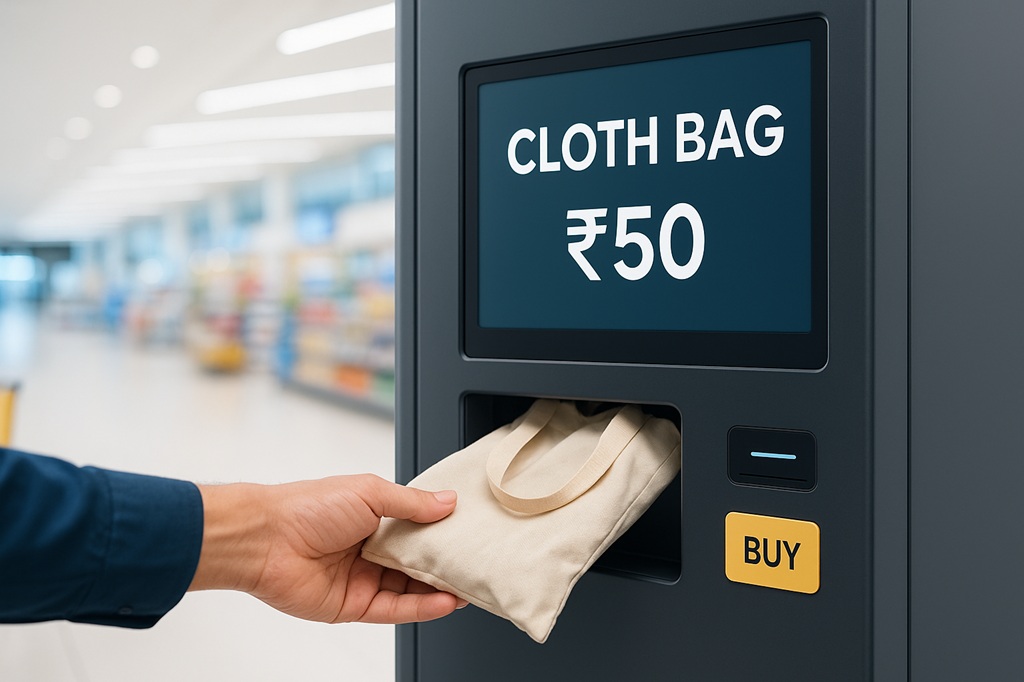
Over the last few years, I’ve noticed something interesting while visiting different cities for installations. Whether it’s a supermarket in Mumbai or a college campus in Nagpur, people have slowly shifted toward cloth bags without making a big fuss about it. Maybe it’s the plastic ban. Maybe it’s guilt. Maybe it’s just convenience. But the demand is definitely there. And that’s exactly why this whole cloth bag vending idea took off faster than even we expected.
At Elevate Info System, we started with a simple thought. If people want to avoid plastic bags, you have to make cloth bags easier to access. No long queues at billing counters. No searching for staff. Just walk up, tap, grab a bag and move on. That was the starting point. And honestly, once we installed a few machines in real places, the response felt almost surprising. Busy malls, government offices, metro stations… everywhere people were quickly adapting to this.
Let me break down everything in the simplest way possible. No fancy jargon. Just the real stuff we’ve learned while building and installing these machines across India.
Why Cloth Bag Vending Machines Are Catching On So Fast
A few years back, shop owners were confused. Customers were confused. Even the staff didn’t know what to give when someone forgot their bag. Plastic got banned and everyone scrambled for alternatives. And in that chaos, store owners kept telling us the same thing. “If we had an easier way to give cloth bags, life would be easier.”
One supermarket owner in Ahmedabad shared a funny story. He said half his customers came back angry because they forgot their bags at home. And when his billing counter got crowded, the whole line slowed down because someone needed just one cloth bag. After he installed the vending machine, those “just one bag” customers stopped disrupting the flow. They simply bought a bag from the machine near the entrance and walked in peacefully.
In schools and colleges, the machines became part of eco-club projects. Students used them during events, and teachers felt they were teaching sustainability without boring lectures. These small moments showed us that adoption wasn’t because the machine was cool. It was because the machine solved a real headache.
How Cloth Bag Vending Machines Actually Work (Explained Normally)
If you crack open one of our machines, you won’t see something magical inside. It’s mostly mechanical parts doing their job in a very predictable way.
Here’s the simplest version of how it works:
1. Bags are loaded inside
Folded cloth bags are stacked neatly in slots or sleeves. A technician or even a store helper can do this.
2. Customer picks a bag
Depending on the model, they either tap a button or choose on a touchscreen.
3. Payment happens
Most people use UPI nowadays. They scan the on-screen QR code and pay instantly. Some machines also take coins or cards, but UPI is easily the hero here.
4. Motor dispenses the bag
Once the machine gets the signal, the motor turns or pushes just one bag forward.
5. Sensors double-check
A sensor checks if the bag has dropped. If not, the machine tries again so nobody feels cheated.
That’s all. The whole process takes less than ten seconds. Honestly, I’ve seen people use the machine even without reading the instructions. The flow is that natural.
One interesting moment I remember was in a mall in Hyderabad. On the first day, a staff member told me, “Sir, people will hesitate… it looks too modern.” By day three, the machine was already running low on bags. Turns out convenience beats hesitation every time.
Cost of Cloth Bag Vending Machines in India
Let me talk straight here. Prices vary a lot because the machine types vary a lot. And if someone tells you there’s one fixed price for every machine, they’re simply not being honest.
Here’s the rough range we’ve seen across the market:
- Smaller button-based machines: around 25,000 to 40,000
- Mid-range UPI + coin machines: usually 45,000 to 65,000
- Touchscreen models with advanced electronics: 70,000 to 1,20,000
- Custom corporate branded machines: depends on capacity and design
What pushes the price up or down?
- Whether it takes UPI or only coins
- How many bags you want it to store
- Bag size configuration
- Type of steel body
- Whether you want IoT monitoring
- Warranty and after-sales support
- Custom printing or branding
A kirana store in Jaipur, for example, only needed a simple 80-bag model. A mall in Bangalore wanted a 300-bag, touchscreen, IoT-enabled model with full-body branding. Obviously, both fall into different price brackets.
One sweet moment I still remember is from a shopkeeper in Indore. He called me a month after installation and said, “Sir, my machine paid for itself already.” He wasn’t exaggerating. When footfall is high, ROI happens quickly.
Features That Actually Matter (From Real-World Usage)
Many buyers get confused because they see glossy brochures with long lists of features. But let me tell you the truth. Most of those features don’t matter if the basics aren’t solid.
Here’s what genuinely matters based on installations across India:
UPI acceptance
If you ask me the single most important feature, it’s UPI. People don’t carry coins anymore. Even in small towns, UPI rules everything.
Smooth dispensing without jamming
Cloth bags are thicker and heavier compared to plastic or paper. The machine should have a motor and dispensing mechanism designed specifically to handle that.
Strong metal body
Especially if the machine is going into a public area. Schools, metro stations, markets… machines face rough handling sometimes.
Good capacity
A supermarket needs a high-capacity machine. A school doesn’t. Simple logic.
Easy refilling
A helper should be able to refill it without calling a technician.
Stable electronics
Touchscreens, sensors and payment modules should be reliable. Cheap electronics cause 90 percent of breakdowns.
Branding support
Many companies want their logo or eco message printed on the machine to build awareness.
At Elevate Info System, we try to build machines as if they’ll be placed in a crowded railway station. Tough, reliable, and easy to use. Anything less fails in real-world India.
Maintenance & Refilling: Honest Expectations
A lot of buyers worry that maintenance will be complicated. To be honest, it’s not. Most of the work is basic upkeep.
Refilling
Depends on footfall. A big mall may need refills every two days. A school may need it weekly.
Cleaning
Wipe the screen, check the bag stack, and make sure the QR code is visible. That’s usually enough.
Sensors
Once in a while, check if any dust or threads are blocking the sensors.
Software
Some machines get automatic updates. A quick restart is usually all they need.
One of our clients in Gujarat refills the machine twice a day. That’s not because the machine is small. It’s because the demand is crazy high there.
Most places won’t have that level of rush, but it’s a good sign of potential.
FAQs
How does a cloth bag vending machine work in retail stores
The machine holds stacks of bags inside. Once a customer selects the option and pays, the motor rotates or pushes the bag down. A sensor checks the drop so that the machine never charges without delivering. The whole thing is smoother than most people expect.
What is the price of a cloth bag vending machine in India
Prices start around 25,000 for basic manual models and can go up to 1,20,000 for touchscreen, UPI-enabled or high-capacity machines. The final cost depends on capacity, features and the kind of place where you want to install it.
Are cloth bag vending machines profitable for supermarkets and malls
Yes, very much. People forget their bags all the time, and they don’t mind paying for a reusable cloth bag. Most big supermarkets recover their cost within a few weeks. Billing counters also become less crowded because bag-buying happens outside the queue.
Which company makes the best cloth bag vending machines for schools and offices
Several companies exist, but Elevate Info System is among the most trusted because our machines are durable and simple to use. Schools and offices prefer us because we customize the machine for their exact bag sizes and daily usage.
Can cloth bag vending machines accept UPI, coins and card payments
Most modern machines accept UPI because that’s what people prefer. Many also accept coins, cards and even wallet payments. UPI remains the fastest and most reliable mode.
What sizes and materials of cloth bags can be dispensed from the machine
The machine works with small cotton bags, medium tote bags or larger reusable shopping bags. Sizes depend on the internal slot configuration. Cloth, canvas and non-woven materials all work smoothly with the right adjustments.
Do cloth bag vending machines require regular maintenance or refilling
Mainly refilling. Maintenance is minimal. Clean the surface, check sensors once in a while and make sure the bags are stacked neatly. Technicians only need to come if there’s some unusual issue.
How many cloth bags can a vending machine store at one time
Small units store around 50 to 80 bags. Larger commercial models hold 200 to 400 bags. For heavy footfall areas like malls, we usually install high-capacity models.
Are cloth bag vending machines suitable for eco-friendly campaigns in public places
Yes, they’re a perfect fit. Many NGOs, colleges and government departments use them to encourage eco-friendly habits. The machine becomes a small but effective part of the campaign.
Where can I buy a cloth bag vending machine with warranty and installation support
Elevate Info System provides machines with warranty, installation and complete support across India. We also help with training staff, branding and bag-size setup so businesses can start using the machine right away.
Why Businesses Choose Elevate Info System
Every machine we install teaches us something about how people interact with technology. And over time, we’ve learned that durability, smooth dispensing and easy payment matter more than any fancy feature.
Businesses choose us because we build machines that survive real Indian conditions. Heat, dust, heavy usage… we design with all that in mind. Our UPI-enabled systems, sturdy metal body and adjustable bag slots make the machines reliable regardless of where they’re placed.
One of our clients in a Delhi government office told us, “We installed it as part of a campaign, but people use it daily.” That’s the kind of result we love seeing.
If you’re looking for a cloth bag vending machine that actually works in the long run, we’re always here to help.